PRODUCT SAFETY INTELLIGENCE REVIEW Q3
Q3 2026 brought new evidence from European market surveillance, the start of CRA reporting obligations and important ENISA guidance. This Review connects the developments to product governance, lifecycle control and practical executive action.

Q3 2026 | July–September 2026
The quarter in product risk, market surveillance, cyber resilience and lifecycle governance
Q3 2026 brought important regulatory developments, including amendments to the EU AI Act and related legislation. Yet some of the quarter's most consequential changes for product governance were operational.
European market-surveillance campaigns exposed gaps between product performance and overall conformity. On 11 September, Cyber Resilience Act reporting obligations became applicable. ENISA published practical guidance on secure product development and procurement, while its September Threat Landscape highlighted the importance of dependencies beyond an organisation's immediate control.
Together, these developments reinforce a fundamental management challenge: maintaining a reliable connection between the product being supplied, its supporting evidence, its evolving risks and the people accountable for decisions throughout its lifecycle.
That is The Readiness Directive's central reading of Q3 2026.
SCOPE AND METHOD
This Review examines selected European developments affecting product safety, market surveillance, cybersecurity, supplier control and lifecycle governance. Findings are selected for their significance, evidentiary strength and relevance to executive decision-making, with preference given to primary and authoritative sources.
Market-surveillance results are reported as findings from the products tested, not as estimates of non-compliance across the wider market. This distinction is important when interpreting both performance and documentation failures.
The Q3 edition places particular emphasis on digital and cybersecurity governance, reflecting the CRA and ENISA developments during the quarter. Two European helmet-surveillance campaigns provide the principal physical-product evidence.
National implementation of Directive (EU) 2024/2853 is covered separately in The Readiness Directive's PLD Implementation Monitor.
EXECUTIVE SUMMARY
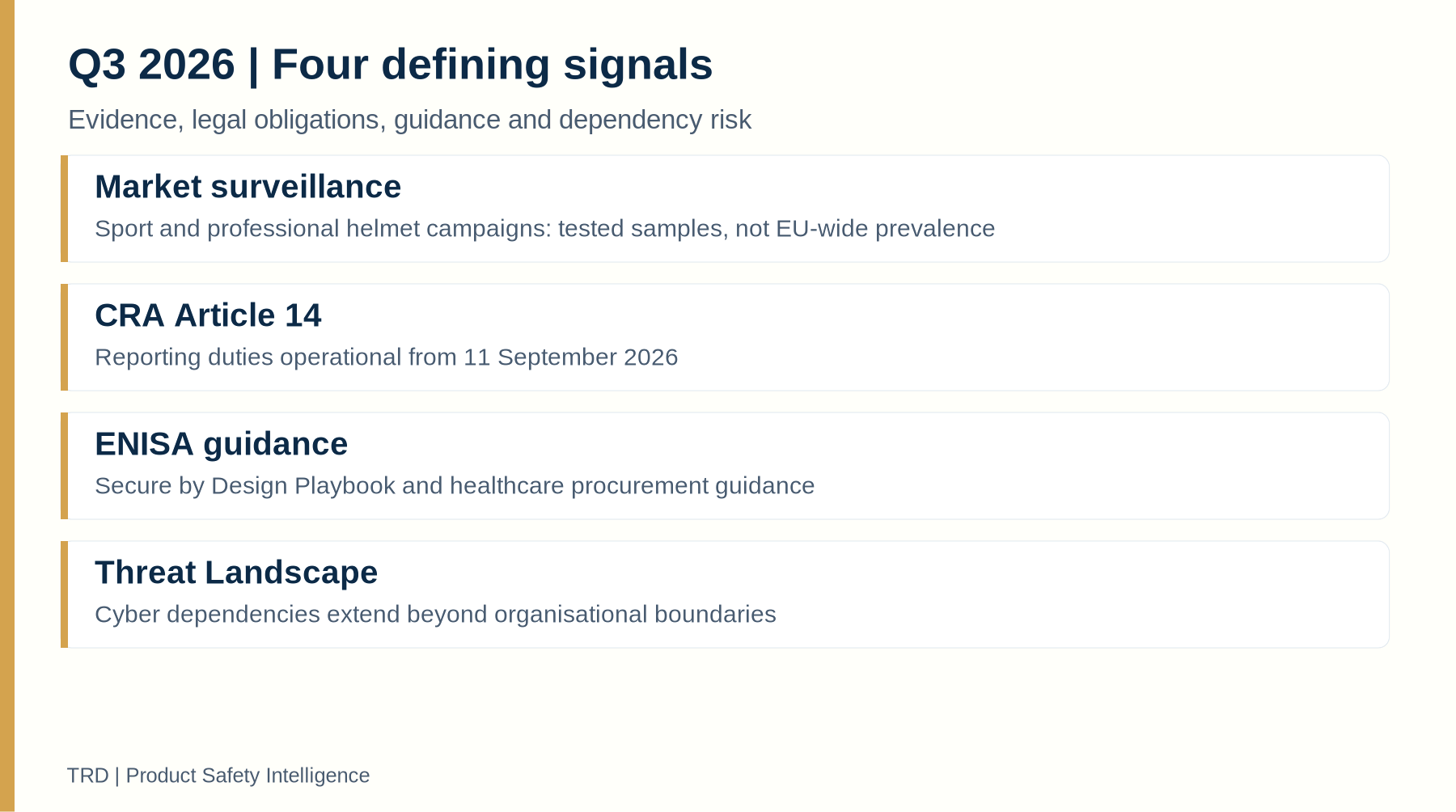
Four developments defined the Q3 intelligence picture.
1. Market surveillance exposed a gap between product performance and overall conformity.
In a European campaign involving 100 sport helmets, 79% passed the performance tests conducted, but only 30% met both performance and formal compliance requirements. A separate campaign involving 65 professional safety helmets found 46 meeting the requirements tested and 19 failing.
These results demonstrate why conformity documentation and physical product performance must be examined together. They describe the tested samples, not the prevalence of non-compliance across the European market. Formal non-compliance must not automatically be equated with physical danger.
2. Cyber Resilience Act reporting became an operational obligation.
From 11 September 2026, manufacturers of in-scope products with digital elements became subject to Article 14 reporting obligations for actively exploited vulnerabilities and severe incidents affecting product security.
The initial reporting milestones are 24 hours and 72 hours from awareness. Although the CRA's broader product-security requirements generally apply from 11 December 2027, the reporting obligations are already in effect.
3. ENISA translated cybersecurity principles into practical guidance.
Its July Secure by Design and Default Playbook and healthcare procurement guidance addressed how security considerations can be integrated into product development, purchasing and lifecycle management.
These publications are guidance, not additional binding legal requirements. Their operational value lies in helping organisations identify responsibilities, dependencies and evidence requirements before problems arise.
4. Cyber dependency risk remained a strategic concern.
ENISA's September Threat Landscape reinforced the significance of interconnected systems, suppliers and external services. Published in Q3, the report analysed activity from 2025 and should not be interpreted as a measurement of Q3 incidents.
For product manufacturers, the management question extends beyond whether an individual product was secure at release. It includes whether the organisation can identify and respond to relevant changes in the dependencies on which that product continues to rely.
The executive conclusion
The common issue is continuity of control.
Product conformity, cybersecurity, supplier management and lifecycle decisions cannot operate as disconnected activities. Management needs to know which product configuration is in use, what evidence supports it, which dependencies matter and who is accountable when circumstances change.
That is the governance challenge connecting Q3's strongest signals.
IN THE MEMBERS' SECTION
The full Review contains the eight-signal register, sector-specific implications, three practical governance tools, the accompanying editable Excel worksheet, the 90-day forward look, seven board questions and the Q4 watchlist.
Legacy edition
This earlier edition is preserved in the archive. The full original publication is available externally where a verified edition link exists.
Read the full original edition on LinkedIn ↗