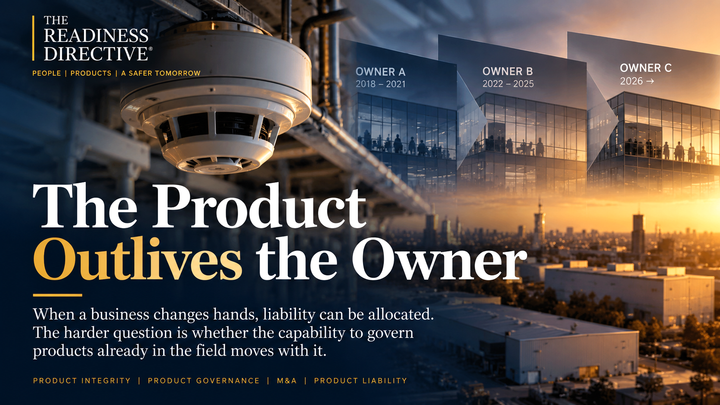
The Product Outlives the Owner
When a business changes hands, liability can be allocated. The harder question is whether the capability to govern products already in the field moves with it.
The question the deal never asked
If a serious defect emerged next year in units shipped eight years ago, who could find them, understand them and act?
Inside a stable company, that question usually has an answer, even if it is an untidy one. Someone knows which service database holds the installed base, which engineer remembers why a threshold was set where it was, and which supplier concession was signed off in the third production year. The answer lives partly in systems and partly in people, and it works because the organisation has stayed in one piece.
A transaction tests whether that answer ever belonged to the organisation at all.
The data room for a manufacturing business holds the contracts, litigation schedule, warranty provisions and a product-liability section reviewed by counsel and reflected in the transaction structure. It rarely asks whether the ability to govern products already in the field will survive the change of owner.
Deal processes are not generally designed around that question, and product organisations are seldom asked to answer it.
Three clocks that keep different time
Every manufacturing business operates against several time horizons. A transaction exposes how far apart three of them can become.
The first is the life of the product.
Life-safety and building systems can remain installed for a decade or more, and industrial equipment considerably longer. Nobody removes a detector from a ceiling simply because the company that manufactured it has been sold.
The second is the liability horizon.
Directive (EU) 2024/2853 applies to products placed on the market or put into service after 8 December 2026, following the May 2026 corrigendum.
Under Article 17, entitlement to compensation generally expires ten years after the relevant product was placed on the market or put into service unless proceedings have already begun. Where an injured person could not initiate proceedings within that period because of the latency of a personal injury, the period extends to twenty-five years. A substantially modified product can start a new period of its own.
The third is the ownership horizon, and it may be considerably shorter.
Private-equity ownership periods are commonly measured in years. Inside a carve-out, the transition services agreement that keeps a separated business operating on its former parent's systems is measured in months. Gartner research, for example, cites a typical TSA duration of around 17 months.
The exact figures will differ from transaction to transaction.
The gap between the clocks is what matters.
A product placed on the market in 2027 could still sit inside the liability horizon in 2037. The business that produced it may have changed ownership once or twice by then, while access to systems containing its history may have disappeared years earlier.
Allocating liability is not the same as moving capability
Deal documents are good at dealing with things that can be identified, scheduled and allocated.
They can move a legal entity or a collection of assets, brands, customer contracts and technical files. They can allocate exposure through disclosure, indemnities, escrows, caps and insurance.
A serious field response depends on something less tidy.
The technical file matters, but so does the design rationale and the people who remember the trade-offs behind it.
Customer contracts matter, but so do installed-base records showing where units are, which configuration they carry and which firmware they are running.
Claims schedules matter, but so do open investigations and concerns that never became formal investigations.
Supplier agreements matter, but so do the deviations, concessions and second-source decisions accumulated over years.
Declared support periods matter, but so do the people and systems required to honour them.
And a transition services agreement matters only for as long as the underlying systems remain accessible.
Much of that information never reaches a data room because it does not exist as a neat transaction document.
It sits in service platforms built to process warranty claims rather than reconstruct failure modes, in configuration records held by installers and integrators, and with engineers who may leave shortly after closing.
Some of it sits inside the seller's shared systems and becomes difficult or impossible to reach once transition arrangements end.
That is the distinction on which the rest of this argument rests.
A transaction can allocate product-liability exposure on paper without demonstrating that the capability required to govern products already in the field has moved with the business.
Product-integrity capability — field visibility, installed-base traceability, design knowledge, support capability, investigation continuity and decision authority — is itself something that must survive a transaction.
It is rarely diligenced as though it were.
What two US cases show
Two US cases illustrate the structure.
They arise under US law and do not predict how an EU court would determine liability. In both, the companies involved disputed liability or resolved claims without admitting it.
What the cases provide is a timeline.
Kidde-Fenwal, an industrial fire detection and suppression business, divested its National Foam firefighting-foam business in 2013. Carrier later became Kidde-Fenwal's ultimate parent following its separation from United Technologies. Kidde-Fenwal subsequently entered Chapter 11 proceedings amid AFFF-related claims.
Following mediation, Carrier entered into a Settlement and Plan Support Agreement in October 2024. The proposed settlement structure remained subject to the bankruptcy process and required approvals.
The important point here is not the US bankruptcy law.
The product line had moved, corporate ownership had changed, yet legacy product exposure remained capable of emerging years later.
Aearo Technologies provides the opposite direction of travel.
Aearo developed and supplied Combat Arms earplugs before 3M acquired the company in 2008. Litigation followed years later. In August 2023, 3M announced a settlement under which it agreed to contribute up to $6 billion between 2023 and 2029. 3M expressly stated that the settlement did not constitute an admission of liability or wrongdoing.
One example involves exposure associated with a business that had been divested. The other involves an acquirer resolving claims concerning a product developed before it owned the business.
Neither tells Europe what its courts will decide.
They do show something more basic: products and product-related exposure can remain relevant long after corporate ownership has changed.
The revised Directive's longer horizons make this kind of ownership-and-product chronology increasingly relevant for European manufacturers, across a wider range of products, including software.
A question every sale process should be able to answer
There is a harder question here, and it deserves to remain a question.
Do transaction incentives create periods in which uncomfortable product information is less likely to be formalised, escalated or priced?
The mechanism is not difficult to understand.
During a sale process, a newly opened field investigation may become a disclosure item. It can generate further diligence, affect contractual allocation and potentially influence valuation.
A concern supported by incomplete evidence may therefore encounter a different organisational environment during a transaction than it would during an ordinary operating period.
Nobody needs to decide deliberately to suppress anything for that tension to exist.
The buyer has its own incentives.
Insurance and contractual protection frequently distinguish between unknown exposure and matters already identified through diligence or disclosure. Discovering a product problem before signing can therefore change both the risk and how that risk is allocated.
That is not an argument for looking less closely.
It is an argument for asking whether the transaction process itself creates conditions that deserve governance.
Boards can test this rather than speculate about it.
Look at the rate at which significant field concerns were opened, escalated and closed in the period around a transaction and compare it with surrounding years.
If nothing changed, the organisation has evidence supporting its confidence.
If the pattern changes materially, someone should understand why.
The seam no function owns
This gap persists because the functions involved in a transaction own different parts of the problem.
Deal teams govern transaction exposure: what is disclosed, indemnified, insured and reflected in price.
Product Safety and Quality govern field risk through post-market surveillance, investigations, corrective action and change control.
Integration and separation teams govern operational continuity, usually concentrating on day-one capability, system migration, transitional services and synergy delivery.
Each function can perform its own job well while the central question remains unanswered:
Will the capability to govern products already in the field survive this transaction?
Part of that question is legal, and some of it remains jurisdiction-specific.
Responsibility for products placed on the market before closing may depend on whether the transaction is structured as a share sale or an asset sale, the contractual arrangements, applicable national law and the identity of the relevant economic operator.
The revised Product Liability Directive does not create a general EU rule governing M&A successor liability.
Likewise, questions concerning the treatment of support commitments following the transfer of a product business require analysis under the applicable regulatory and transaction structure rather than assumption.
Those are matters for counsel.
The larger part of the problem is operational, and no legal opinion can solve it.
Can the new owner identify the installed population?
Can it read the service and configuration history?
Is anyone still employed who understands the design decisions that an authority or court may later examine?
Does somebody have authority to initiate a field action concerning a product manufactured before the business changed hands?
Those answers are often determined during integration — sometimes simply by which systems, records and people survive it.
Before the next deal
Boards approve acquisitions and divestitures on valuation, strategic fit, risk allocation and legal protection.
They are rarely asked to approve the continuity of the products the business has already put into the world.
A seller should be able to answer:
Which obligations to products already in the field remain with us after closing, and will we still possess the records, systems and people required to meet them?
A buyer should be able to answer:
Which installed-base obligations are we acquiring, which of them have actually been priced, and which depend on systems or expertise that disappear when transition arrangements end?
Both should be willing to ask one more uncomfortable question:
Did any product concern remain informal during the transaction because the evidence was incomplete, ownership was changing or the timing was inconvenient?
Everything returns to one test.
If a serious defect emerged next year in units shipped eight years ago, could the current owner find them, understand them and act?
If that answer depends on who owned the company when the product was made, the business has a continuity problem that no indemnity can solve.
Sources and further reading
European Union
Directive (EU) 2024/2853 on liability for defective products — EUR-Lex
Corrigendum to Directive (EU) 2024/2853 — May 2026 — EUR-Lex
Transaction continuity
Gartner — M&A Transition Services Agreements: Data for Key Terms
Kidde-Fenwal / Carrier
Carrier Global Corporation — Form 8-K, October 2024 — Settlement and Plan Support Agreement
3M / Aearo
3M Company — Form 8-K, August 2023 — Combat Arms Settlement
The Readiness Directive provides independent analysis of product integrity, product governance, product liability and regulatory readiness. References to legal requirements are provided for context and should not be treated as jurisdiction-specific legal advice.
Legacy edition
This earlier edition is preserved in the archive. The full original publication is available externally where a verified edition link exists.
Read the full original edition on LinkedIn ↗Related Intelligence
Product Integrity
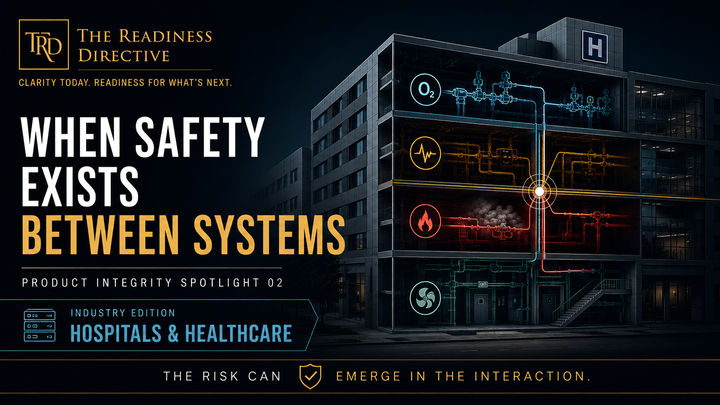
When Safety Exists Between Systems
A hospital fire reveals how individually governed systems can create combined safety conditions. What Turku teaches us about Product Integrity, evidence, system interaction and the revised EU Product Liability Directive.
Product Integrity
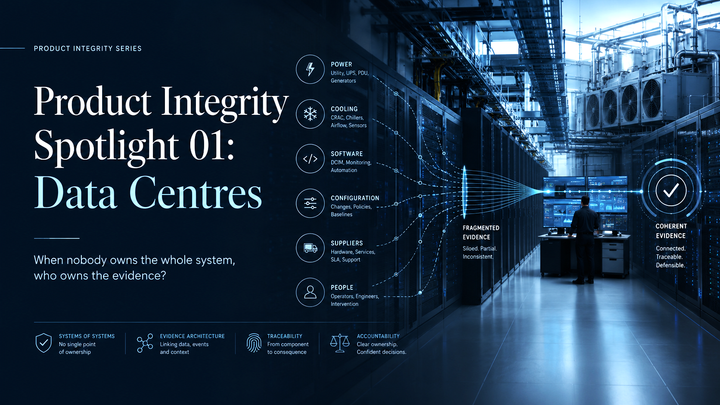
Product Integrity Spotlight 01: Data Centres
A data centre can have world-class redundancy and still lack a complete account of what actually existed when something went wrong.