The Visibility Gap
The Visibility Gap, Part 3
Public product safety data reveals formal action, but not every weak signal, unresolved investigation or hidden risk that preceded it.
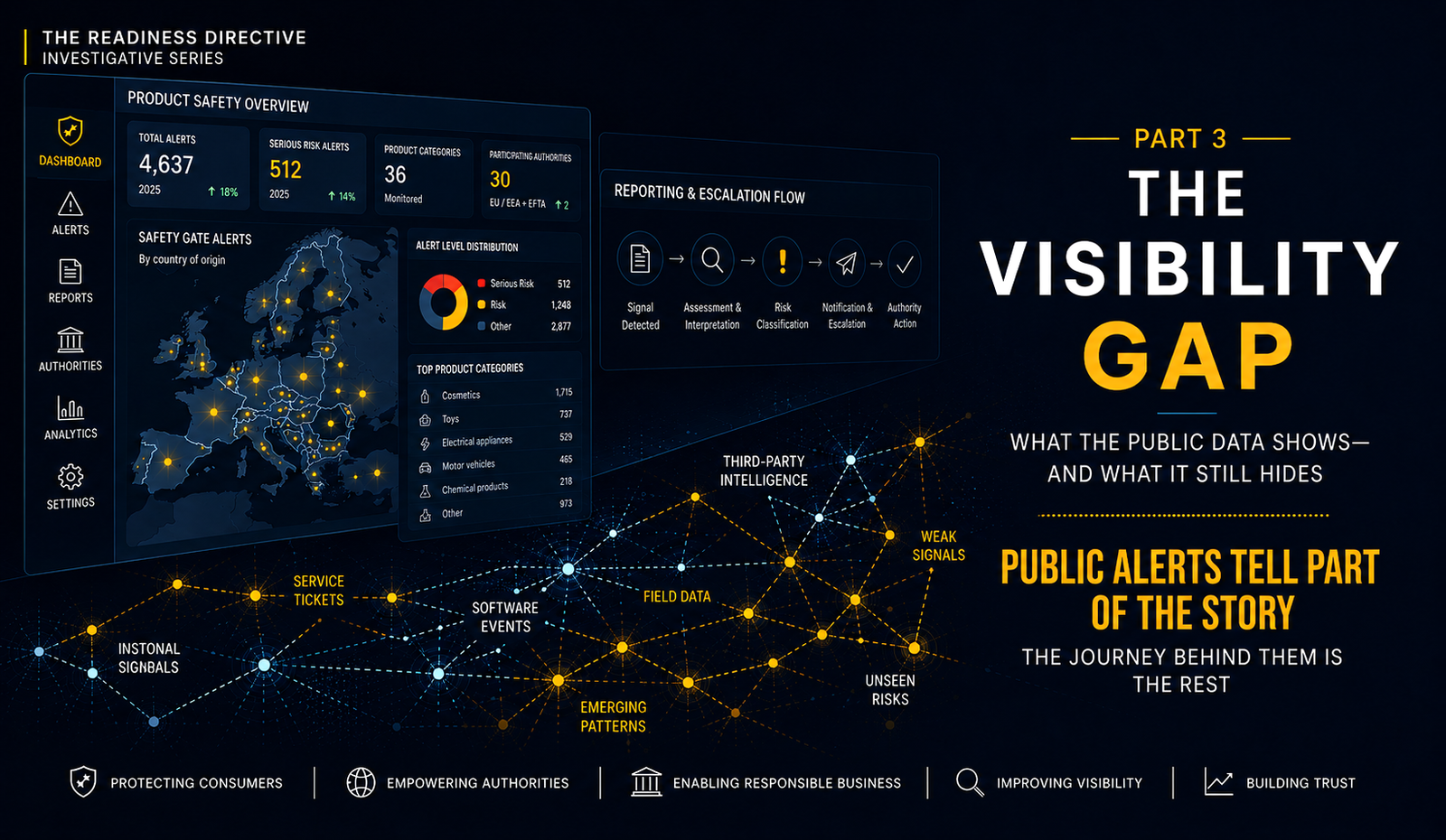
What the public data shows, and what it still hides
The Visibility Gap is a four-part investigation into how product safety signals are detected, interpreted, escalated and made visible before harm occurs. New parts are published weekly throughout August.
Public product safety data creates an impression of visibility.
A Safety Gate alert, recall notice or public warning gives an issue a recognisable form. The product is identified, the hazard is described and corrective action becomes visible.
The harder question is whether the public record shows the whole risk picture, or only the part that has already passed through internal investigation, legal classification and formal regulatory processing.
As Part 2 explored, every public alert is usually the end of a longer journey. Signals must be detected, interpreted, escalated and assessed against reporting obligations before they can enter the external record.
The visible alert is therefore not raw reality. It is the outcome of evidence, judgement, regulatory thresholds and authority processing.
Public product safety data matters enormously. But it is best understood as a map of formalised visibility.
What the public record represents
Across the European Union, national authorities exchange information about dangerous products through the Safety Gate Rapid Alert System.
The public Safety Gate Portal performs a related but distinct role. Article 34 of the General Product Safety Regulation requires the European Commission to make selected information from those notifications available to the public.
That distinction matters because authority visibility and public visibility are connected, but they are not identical. The public record is an external view of information that has already passed through formal regulatory channels.
A similar distinction exists in Great Britain. Businesses notify the appropriate enforcement authority under the applicable legislation. Information may then be recorded and shared through the UK Product Safety Database, while the Office for Product Safety and Standards separately publishes Product Safety Alerts, Reports and Recalls for public access.
The public record therefore tells us where product risk has reached formal regulatory significance. It does not reveal every uncertainty, investigation or internal decision that preceded it.
What public data shows well
Public product safety data is strong at the task it was designed to perform.
It identifies products assessed as dangerous, describes recognised hazards, records corrective measures and helps authorities coordinate across markets. It also allows businesses, consumers and policymakers to observe patterns in the product categories, risk types and actions that reach formal visibility.
The European Commission’s Safety Gate report for calendar year 2025 recorded 4,671 alerts, the highest annual total since the system began in 2003 and 13% more than in 2024. Authorities also recorded 5,794 follow-up actions, an increase of 35%.
Cosmetics accounted for 36% of alerts, toys for 16%, and electrical appliances and equipment for 11%. Chemical risks represented 53% of notifications, followed by injuries at 14% and choking at 9%.
Those figures provide useful intelligence. They show which products and hazards are repeatedly reaching the formal system, and they demonstrate increasing regulatory activity after alerts have been issued.
But they should not be interpreted as a complete inventory of product risk.
The silence problem
Many meaningful product safety concerns spend time in a partially visible state.
Evidence may be incomplete, behaviour may be intermittent and functions may disagree about causality or seriousness. Quality may be unable to reproduce an issue, Engineering may still be analysing the technical mechanism and Regulatory may not yet know whether the reporting threshold has been crossed.
Near misses, weak internal signals, unresolved investigations, escalation delays and concerns that remain below formal reporting thresholds will rarely appear in a public alert database. That is not a defect in the system. Public reporting mechanisms were not designed to publish every complaint, preliminary hypothesis or internal debate.
The risk arises when the absence of a public alert is treated as reassurance.
A Board reviewing public alerts may reasonably conclude that the external environment appears stable. At the same time, an internal product safety team may be investigating several emerging concerns that have not yet reached reportable status.
Both views may be accurate.
They are simply looking at different stages of visibility.
Silence in the public layer is not necessarily silence inside the business.
Why software makes the gap harder to read
Software-defined products make the boundary between visible and invisible risk harder to interpret.
Traditional hazards are often associated with comparatively stable physical conditions such as overheating, breakage, contamination, chemical exposure or mechanical failure. Software-related risk may instead be intermittent, version-specific, configuration-dependent or influenced by external infrastructure.
Consider a connected home device that receives a firmware update. Most units continue to operate normally, but a small proportion begin showing latency in a safety-relevant function. The behaviour appears only under one network configuration and only after a cloud-side service change.
Customer Support receives isolated complaints, Engineering identifies instability and the software team sees configuration-dependent variation. No single dataset establishes the complete event, but together the signals may indicate a genuine product safety concern.
The difficulty is not necessarily recognising that something changed. It is assembling distributed evidence into a coherent safety assessment capable of supporting a regulatory decision.
Until that happens, the issue may remain absent from the public record even though it is already operationally significant.
The revised Product Liability Directive expressly brings software within the EU product-liability framework. That increases the importance of understanding updates, related services and post-release product behaviour, as well as preserving the evidence behind lifecycle decisions.
Why cross-market comparisons require caution
Public datasets can create an illusion of straightforward comparability.
Alert totals, risk classifications and corrective actions may appear to offer a simple way to compare markets. In practice, the data reflects different legal frameworks, reporting periods, administrative processes and publication practices.
Safety Gate’s figures cover the calendar year 2025.
The latest UK Product Safety Database report covers 1 April 2024 to 31 March 2025. It recorded 1,418 notifications involving 1,792 products. Of those notifications, 24% were classified as serious risk, while 44% had no assigned risk level.
That final figure is particularly important.
More than four in ten notifications in the UK dataset carried no assigned risk classification. That does not make the record useless. It demonstrates why public data must be interpreted within the limits of the system that produced it.
The same report states that import rejection at the border accounted for 35% of corrective actions. That tells us something about enforcement activity, but it does not translate directly into a measure of underlying consumer risk.
The EU and UK figures therefore should not be read as competing risk scores. They measure different systems, different periods and different administrative practices.
A lower alert total may reflect lower risk. It may also reflect different legal duties, classification approaches, authority resources, enforcement priorities or publication conventions.
Public data can support comparison.
It cannot replace contextual judgement.
How the public record should be read
Public product safety data should be treated as structured evidence with known boundaries.
It can help organisations identify recurring hazards, review external regulatory activity, monitor product categories and challenge assumptions about their own portfolios. It can also show where formal visibility is increasing and where authorities are concentrating corrective action.
But the most disciplined use of the data is to ask what lies behind it.
Which issues become visible repeatedly? Which risks remain difficult to express through traditional hazard categories? Are software-related concerns appearing clearly, or only after they produce more recognisable physical consequences? Do differences between markets reflect underlying risk, reporting practice or both?
The objective is neither to dismiss the public record nor to treat it as complete.
It is to understand what the evidence can support, and where interpretation begins.
Final thought
Public product safety data protects consumers, supports regulatory coordination and gives organisations valuable external intelligence.
But the visible record is not the full risk record.
Once the visible data ends, judgement begins.
Next in the series
Part 4 concludes The Visibility Gap by examining what organisations should build internally if visibility is understood as a governance capability rather than merely a reporting process.
The final question is unavoidable:
What must organisations change so that important product safety signals do not remain invisible until it is too late?
Sources and references
European Commission, Safety Gate Annual Report 2025
https://op.europa.eu/webpub/just/safety-gate-2025-report/en/
European Commission, Safety Gate Rapid Alert System
https://ec.europa.eu/safety-gate/
European Commission, Safety Business Gateway
https://webgate.ec.europa.eu/safety-business-gateway/
Regulation (EU) 2023/988, General Product Safety Regulation
https://eur-lex.europa.eu/eli/reg/2023/988/oj/eng
UK Government, Product Safety Database report 2024 to 2025
https://www.gov.uk/government/statistics/product-safety-database-annual-reports/product-safety-database-report-2024-to-2025
UK Government, Product Recalls and Alerts
https://www.gov.uk/guidance/product-recalls-and-alerts
UK Government, Business notifications of unsafe and noncompliant products
https://www.gov.uk/government/publications/business-notifications-of-unsafe-and-noncompliant-products
UK Government, Product safety and noncompliance notification guidance
https://www.gov.uk/government/publications/notifications-of-unsafe-and-noncompliant-products/product-safety-and-noncompliance-notification-guidance
UK Government, General product safety regulations, Northern Ireland
https://www.gov.uk/government/publications/general-product-safety-regulations-northern-ireland
Directive (EU) 2024/2853, revised Product Liability Directive
https://eur-lex.europa.eu/eli/dir/2024/2853/oj/eng