EU Product Liability Directive
EU 2024/2853: Are you structurally ready, or just watching?
From 9 December 2026, products placed on the EU market, including products from lines already in production, enter the new liability regime. Tracking transposition will not tell you whether you could reconstruct their history.
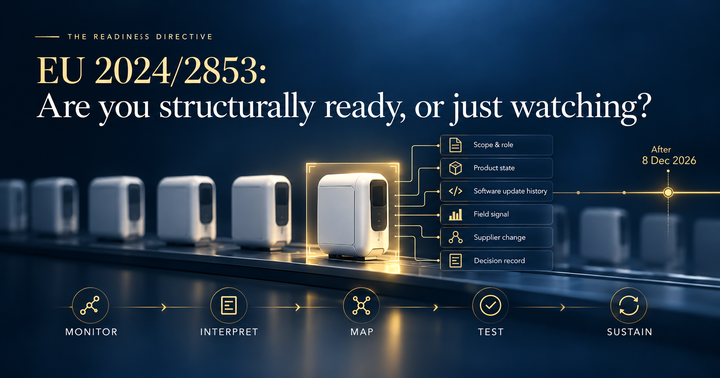
From 9 December 2026, products placed on the EU market, including products from lines already in production, enter the new liability regime. Tracking transposition will not tell you whether you could reconstruct their history.
When I first asked in March whether organisations were structurally ready for Directive (EU) 2024/2853, the December deadline still felt some distance away. It does not now.
Following the corrigendum of 7 May 2026, Article 2(1) applies the new Directive to products placed on the market or put into service after 8 December 2026. Article 21 provides that Directive 85/374/EEC continues to apply to products placed on the market or put into service before 9 December 2026.
The transition does not simply follow the launch date of a product model. The legal trigger is when the product concerned is placed on the market or put into service. Organisations may therefore need to distinguish populations of the same product according to when they were placed on the market or put into service.
That changes the practical question. It is no longer only what governments are doing about transposition, but which product populations will enter the new regime and whether the organisation could account for them if tested.
Why monitoring is not readiness
I have spent much of 2026 tracking implementation across all 27 Member States for The Readiness Directive’s monthly Implementation Monitor. Knowing where a government is in the legislative process tells you when, and through which national procedure, the new framework is taking shape. It does not tell you whether your organisation could reconstruct one of its own product decisions tomorrow.
Article 3 makes the Directive fully harmonising: unless the Directive provides otherwise, Member States may not maintain or introduce diverging rules, whether more or less stringent. National procedure, the options expressly left open by the Directive and other national liability grounds outside liability for product defectiveness still matter.
The substantive framework is nevertheless already visible. Software falls within the definition of a product. Manufacturer control can extend beyond initial placement on the market. Article 9 establishes mechanisms for court-ordered disclosure, Article 10 creates defined rebuttable presumptions, and Article 11 addresses circumstances in which later product state, software, updates and related services remain relevant to liability.
Readiness, in the framework proposed here, is something different: it is what the organisation can demonstrate for the products it is actually governing.
Readiness belongs to a product population
A company may have excellent product-state visibility for one portfolio and weak visibility for another. A recently acquired business may retain different systems and suppliers. One product may receive centrally controlled software updates while another is configured by integrators in the field. Products from the same line may also fall on different sides of the transition depending on when they were placed on the market or put into service.
Enterprise capability is what the organisation has built: its systems, processes, expertise and authority. Product-population readiness is what it can demonstrate for a defined population of products. The first enables readiness; the second is what scrutiny eventually tests.
A useful population can therefore be defined by factors such as product family, software dependency, supplier model, acquisition history, installed-base visibility and date of placement on the market. The enterprise view is not an average. It is the weakest material population that matters.
This changes the pathway from a corporate badge into a prioritisation tool.
Which populations are ready, which are not, and which would we least want selected for reconstruction tomorrow?
The PLD Readiness Pathway
The pathway has five stages:
Monitor → Interpret → Map → Test → Sustain
This pathway is narrower than a general assessment of product-governance capability: it asks what can be demonstrated, for a defined product population, against one Directive.
The stages are analytical tools developed by The Readiness Directive. They are not classifications contained in the legislation, and operational work will not always move through them in a perfectly linear sequence.
Stage 1 · Monitor
At Stage 1, the organisation knows the Directive exists, follows national implementation and receives legal or regulatory updates, but there is little evidence that the operating model has changed. There may be no defined population view, no determination of which products sit on which side of the transition and no test of whether existing records could reconstruct a relevant product decision.
A Stage 1 organisation can answer:
What is changing in the law?
What have we changed because of it?
Evidence that you are here: monitoring records and legal briefings exist, but there is little evidence of resulting operational change.
Stage 2 · Interpret
At Stage 2, legal understanding has been converted into explicit determinations for a defined product population:
- which products and software are in scope;
- whether related services are relevant;
- which legal entity holds which economic-operator role;
- where manufacturer’s control may continue after placement on the market;
- which side of the December transition the population sits.
Article 4 expressly includes software in the definition of a product and defines related services and manufacturer’s control. Article 8 identifies the economic operators that may be liable. Those concepts remain abstract until the organisation determines how they apply to its own products and entities.
The output is a documented scope-and-role determination for the population: what is in scope, who holds which role, where manufacturer’s control continues and which side of the transition each product falls on, with a named owner, stated assumptions and a review date.
Evidence that you are here: a documented and owned scope-and-role determination exists for the population.
Stage 3 · Map
At Stage 3, the organisation identifies where the product account actually lives: product-state history; software and firmware versions; supplier decisions; relevant instructions; field intelligence; material risk assessments and approvals; and known gaps.
The exercise frequently exposes a problem that ordinary record retention can hide.
Every record can exist and the product account can still be incomplete.
Engineering may hold one part, Quality another, Procurement another and Service another. The issue may not be that information is absent. It may be that nobody has previously needed to join it.
Evidence that you are here: for a named population, the organisation can show where the important elements of the product account sit and identify the known gaps.
Legacy edition
This earlier edition is preserved in the archive. The full original publication is available externally where a verified edition link exists.
Read the full original edition on LinkedIn ↗Related Intelligence

EU Product Liability Directive
The Directive Is Horizontal. Your Org Chart Is Vertical.
The EU Product Liability Directive cuts across functions. The challenge before December is not rewriting policies - it is making decision rights work across the organisation.
EU Product Liability Directive
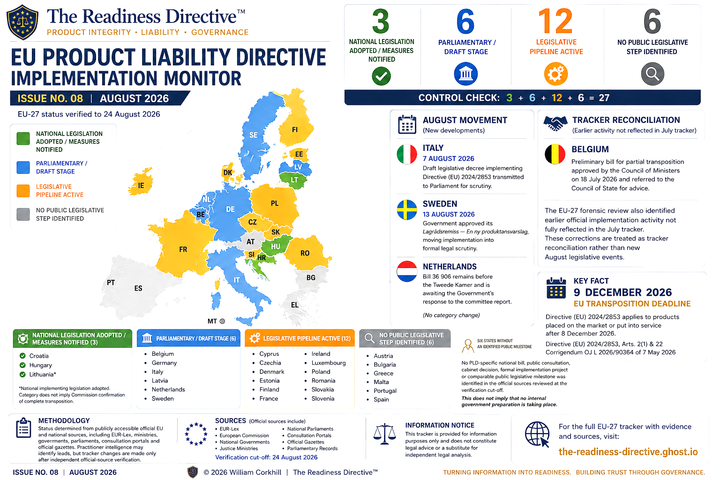
EU Product Liability Directive Implementation Monitor - August 2026
EU-27 implementation of Directive (EU) 2024/2853 is moving into formal legislative machinery. August status: 3 adopted/notified, 6 parliamentary, 12 pipeline, and 6 with no public legislative step identified.
EU Product Liability Directive
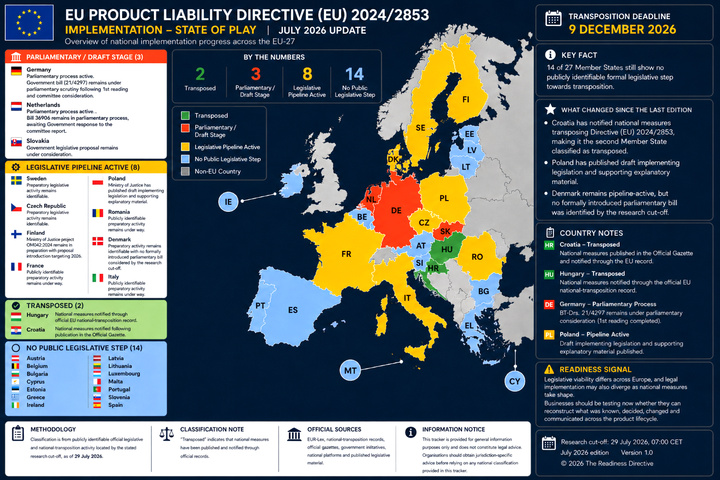
EU Product Liability Directive Implementation: State of Play -July 2026
the approved Croatia/14 Member States summary