EU Product Liability Directive
EU Product Liability Directive Implementation Monitor - August 2026
EU-27 implementation of Directive (EU) 2024/2853 is moving into formal legislative machinery. August status: 3 adopted/notified, 6 parliamentary, 12 pipeline, and 6 with no public legislative step identified.
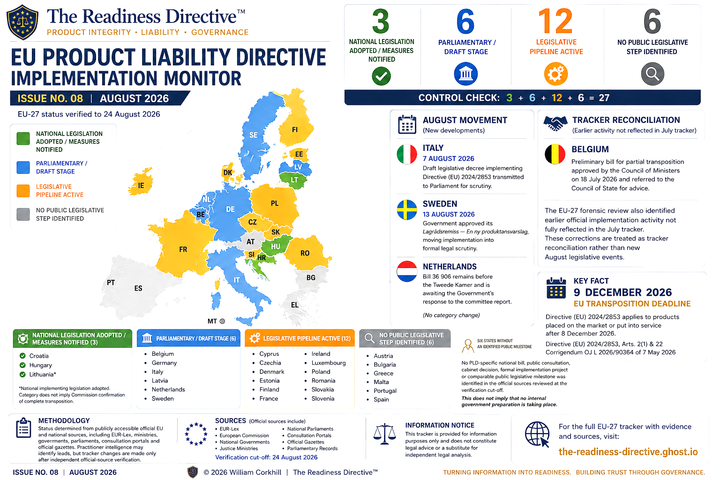
Implementation is beginning to move into formal legislative machinery
Issue No. 08 | August 2026
EU-27 status verified to 24 August 2026
The implementation picture for Directive (EU) 2024/2853 is becoming more developed but not necessarily more uniform.
The August edition of The Readiness Directive™ EU Product Liability Directive Implementation Monitor places the 27 Member States across four stages:
3 — National legislation adopted / measures notified
6 — Parliamentary / Draft Stage
12 — Legislative Pipeline Active
6 — No Public Legislative Step Identified
The numbers tell only part of the story.
The more significant development this month is that implementation is beginning to move from ministry preparation, consultation and working groups into formal legislative and legal scrutiny.
Italy and Sweden provide the clearest August examples.
At the same time, this month’s forensic EU-27 review identified earlier national developments that were not fully reflected in the previous tracker. Those changes are recorded separately as tracker reconciliation, rather than being presented as new August legislative events.
That distinction matters.
A monthly implementation monitor should show not only what the evidence says today, but also when the underlying event actually happened.
EU-27 state of play
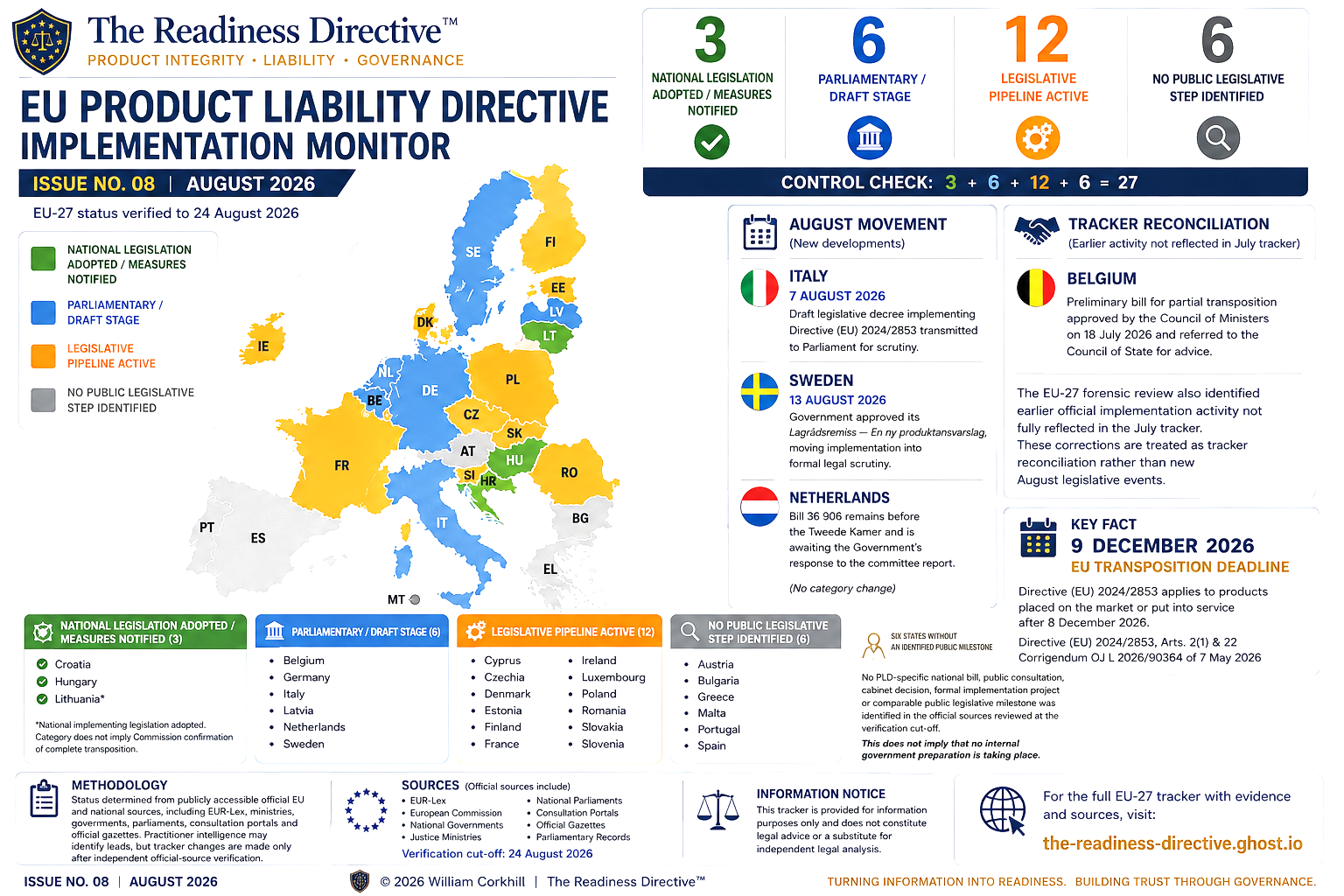
3 - National legislation adopted / measures notified
Croatia · Hungary · Lithuania
6 - Parliamentary / Draft Stage
Belgium · Germany · Italy · Latvia · Netherlands · Sweden
12 - Legislative Pipeline Active
Cyprus · Czechia · Denmark · Estonia · Finland · France · Ireland · Luxembourg · Poland · Romania · Slovakia · Slovenia
6 - No Public Legislative Step Identified
Austria · Bulgaria · Greece · Malta · Portugal · Spain
Control total: 3 + 6 + 12 + 6 = 27.
Every EU Member State is represented once.
What changed in August
Italy - parliamentary scrutiny begins
On 7 August 2026, the Italian Government transmitted Atto del Governo n. 434 to Parliament for opinion.
The draft legislative decree expressly implements Directive (EU) 2024/2853.
Italy therefore moves from Legislative Pipeline Active into Parliamentary / Draft Stage.
The significance is not simply another country changing colour on the map.
A national implementation project has moved from preparation into formal parliamentary scrutiny, creating a more developed public record against which businesses can begin to assess the likely national implementation route.
Sweden - formal legal scrutiny
Sweden also moved category during August.
At its meeting on 13 August 2026, the Swedish Government approved a Lagrådsremiss entitled En ny produktansvarslag.
That takes the proposed legislation beyond the earlier investigation and consultation phase and into formal scrutiny by the Council on Legislation.
Sweden therefore moves from Legislative Pipeline Active into Parliamentary / Draft Stage.
Netherlands - parliamentary process continues
The Dutch implementation bill, 36 906, remains before the Tweede Kamer.
The current parliamentary position records that the chamber is awaiting the Government’s response to the committee report.
This is procedural movement rather than a category change.
The Netherlands therefore remains within Parliamentary / Draft Stage.
The headline is public. The evidence behind it is available to members.
The August map shows where the EU-27 currently stands.
The full monitor goes further: the evidence behind the classifications, tracker reconciliation, national implementation detail, the six states without an identified public milestone, methodology and the implications for organisations preparing for December.
Join The Readiness Directive free to continue with the complete EU-27 Implementation Monitor.
The August state of play - country evidence
National legislation adopted / measures notified - 3
Croatia · Hungary · Lithuania
This category deliberately captures closely related but not identical forms of implementation progress.
Croatia and Hungary have national transposition measures communicated through EUR-Lex.
Lithuania has adopted national implementing legislation.
That distinction matters.
Inclusion in this category should not be read as a European Commission determination that national transposition is complete or legally correct.
Formal notification of national measures and independent assessment of the completeness or conformity of those measures are different things.
For that reason, the monitor uses the broader heading:
National legislation adopted / measures notified.
Croatia
Amendments to the Croatian Obligations Act were adopted in June 2026 and published in Narodne novine 69/2026.
The relevant new product-liability provisions apply from December 2026.
Hungary
Hungary remains among the most advanced Member States, with national implementing measures already adopted and communicated.
Lithuania
Lithuania adopted national implementing legislation in June 2026.
Its inclusion in this category reflects that national legislative milestone and should not be interpreted as a statement that the European Commission has independently confirmed complete transposition.
Parliamentary / Draft Stage - 6
Belgium · Germany · Italy · Latvia · Netherlands · Sweden
These Member States have moved beyond general preparation into a formal government-approved draft, parliamentary procedure or comparable formal legal scrutiny.
Belgium
The Belgian Council of Ministers approved a preliminary bill for partial transposition of Directive (EU) 2024/2853 on 18 July 2026 and referred it to the Council of State for advice.
Belgium’s appearance in this category is a tracker reconciliation rather than a new August development.
More on that below.
Germany
Germany remains within the Bundestag process through Government Bill 21/4297.
The bill has undergone parliamentary referral and expert scrutiny, including the committee hearing held on 13 April 2026.
Germany therefore remains one of the Member States where the national implementation route is already substantially visible.
Italy
Italy moved into this category during August following transmission of Atto del Governo n. 434 to Parliament on 7 August.
Latvia
Latvia has progressed beyond preparatory consultation into a government-approved draft process.
Netherlands
Bill 36 906 remains before the Tweede Kamer.
The current stage is awaiting the Government’s response to the committee report.
Sweden
Sweden entered formal legal scrutiny during August through the Government’s Lagrådsremiss — En ny produktansvarslag.
Legislative Pipeline Active - 12
Cyprus · Czechia · Denmark · Estonia · Finland · France · Ireland · Luxembourg · Poland · Romania · Slovakia · Slovenia
These jurisdictions have a publicly identifiable implementation process but have not yet crossed the threshold used by this monitor for Parliamentary / Draft Stage.
The evidence includes public consultations, ministry implementation projects, government programmes, official draft preparation and other identifiable national transposition activity.
Finland
Finland remains within Justice Ministry project OM042:00/2024.
The working-group proposal has already undergone consultation and the project remains in further preparation.
Slovakia
Slovakia remains within the pipeline category because the official evidence supports preparation of an academic transposition proposal for submission to the Ministry rather than a formal government or parliamentary bill.
This distinction illustrates an important part of the methodology.
A document may be described colloquially as a “draft” without having reached the formal legislative threshold used by this tracker.
Cyprus
Cyprus has published proposed implementing legislation through its official consultation process.
Czechia
Official ministry work towards implementation remains identifiable.
Denmark
A national legislative preparation and consultation route is publicly visible.
Estonia
Official implementation planning identifies work on transposing Directive (EU) 2024/2853.
France
The Ministry of Justice has identified an interministerial transposition process led through the relevant civil-affairs directorate.
Ireland
The responsible Department has publicly confirmed that assessment of the Directive’s transposition requirements has begun.
Luxembourg
The Ministry of Justice has publicly identified national transposition work.
Poland
Official draft implementation work is publicly available.
Romania
Official national planning identifies legislative work towards implementation.
Slovenia
The Ministry of Justice has an identifiable official draft-law process underway.
No Public Legislative Step Identified - 6
Austria · Bulgaria · Greece · Malta · Portugal · Spain
This category requires careful interpretation.
It does not mean that these governments are doing nothing.
It means that, at the 24 August 2026 verification cut-off, the review did not identify a PLD-specific national bill, public consultation, cabinet decision, formal implementation project or comparable publicly accessible legislative milestone through the official sources examined.
Internal government drafting, interdepartmental coordination or administrative preparation may still be taking place.
The tracker reports the publicly evidenced position.
It does not infer the absence of internal activity merely because that activity has not yet entered the public record.
For organisations operating in these six jurisdictions, however, the visibility gap still matters.
A public legislative route gives legal, compliance, product, insurance and operational teams something concrete against which to plan.
Where that route is not yet visible, organisations still have to prepare — but with less national detail on which to anchor those preparations.
Tracker reconciliation: what the deeper audit changed
The August review was deliberately broader than a search for developments occurring during the month.
All 27 Member States were re-examined through national government, ministry, parliamentary, consultation, legislative-planning and official-gazette channels.
That produced an important editorial distinction.
Some changes to the August map represent new August legislative activity.
Others represent earlier official developments that the previous tracker had not fully captured.
We do not treat those as equivalent.
Belgium - a community correction independently verified
Belgium is the clearest example.
After publication of the July monitor, a Belgian legal practitioner contacted The Readiness Directive privately to point out that the Belgian position had moved beyond the status shown in the report.
The information was then independently checked against the Belgian Government’s own record.
The Council of Ministers had approved a preliminary bill on 18 July 2026 aimed at partial transposition of Directive (EU) 2024/2853 and sent it to the Council of State for advice.
The August tracker therefore corrects Belgium’s classification.
It does not present the 18 July decision as an August event.
A particular thank you to the practitioner who took the time to raise the issue.
We are also grateful to members of the wider European legal community who continue to circulate the monitor, share national developments and challenge the evidence behind it.
That support improves the work.
But the editorial rule remains straightforward:
Practitioner intelligence can identify a lead. Official evidence determines whether the tracker changes.
Why visibility and activity are not the same thing
A public implementation tracker can measure only what becomes visible through accessible official sources.
That is not the same thing as measuring everything occurring inside a government.
A ministry may be drafting before a consultation appears.
A cabinet proposal may be undergoing internal coordination before it reaches Parliament.
A translation, explanatory memorandum or legal review may exist before a searchable public record is created.
That is why this edition uses:
No Public Legislative Step Identified
rather than:
No implementation activity.
The distinction is important for both accuracy and fairness.
The legal date has not moved
Member States must bring the laws, regulations and administrative provisions necessary to comply with Directive (EU) 2024/2853 into force by:
9 December 2026
There is a separate but important point concerning the Directive’s application.
The Official Journal published a corrigendum on 7 May 2026 correcting Article 2(1).
The Directive applies to products placed on the market or put into service:
after 8 December 2026
This replaces the original wording referring to products placed on the market or put into service after 9 December 2026.
For organisations managing product portfolios, release dates, installed bases and post-market changes, that distinction should be carried accurately into implementation planning.
What the August picture means for business
The most interesting feature of the August map is no longer simply the number of countries with implementation activity.
It is the stage transition.
Government preparation is beginning to become parliamentary procedure, formal legal scrutiny and adopted national legislation.
That changes the quality of the information available to organisations.
Draft legislation begins to reveal national drafting choices.
Parliamentary scrutiny exposes areas of disagreement.
Explanatory memoranda show how governments understand the Directive.
Final legislation begins to remove one form of uncertainty while creating the practical implementation task that follows.
For multinational businesses, the challenge increasingly becomes:
Can the organisation translate 27 developing legal positions into one coherent product-governance response?
The Directive is harmonised European legislation.
Implementation still arrives through national legal systems.
The operational burden sits between those two facts.
What we will watch next
The September monitor will look particularly for whether:
- Sweden progresses from the Lagrådsremiss towards a Government proposition;
- Italy advances Atto del Governo n. 434 through parliamentary scrutiny;
- Germany and the Netherlands progress their existing parliamentary files;
- Belgium moves beyond Council of State review;
- Finland moves from further preparation towards a Government proposal;
- Slovakia produces the planned transposition proposal;
- one or more of the six states without an identified public milestone publishes a formal implementation route;
- additional national measures appear through EUR-Lex.
Any material official development occurring after the August evidence cut-off will be reflected in the next verified position.
Methodology
The monitor classifies Member States according to publicly accessible official evidence.
Sources reviewed include EUR-Lex, European Commission material, national governments, justice and other responsible ministries, national parliaments, official consultation portals, legislative-project databases and official gazettes.
The classification represents the most advanced publicly evidenced implementation milestone identified at the verification cut-off.
Secondary commentary, law-firm updates and practitioner intelligence may identify possible developments, but a tracker classification changes only after independent verification against an appropriate official source.
The four categories used by the monitor are editorial monitoring categories created by The Readiness Directive™.
They are not classifications issued by the European Commission.
EUR-Lex national-transposition notifications are treated separately from the monitor’s broader assessment of national legislative progress.
Primary official records checked for this edition
European Union
Directive (EU) 2024/2853
EUR-Lex national transposition measures
Official Journal corrigendum OJ L 2026/90364
Italy
Atto del Governo n. 434
Sweden
En ny produktansvarslag — Government Lagrådsremiss
Netherlands
Tweede Kamer — Bill 36 906
Belgium
Belgian Council of Ministers — preliminary bill for partial transposition, 18 July 2026
Germany
Deutscher Bundestag — Government Bill 21/4297 and related committee proceedings
Additional official national sources were reviewed across all 27 Member States.
Information notice
This monitor is provided for information purposes only and does not constitute legal advice or a substitute for independent legal analysis.
National implementation may change after the verification cut-off.
Verification cut-off: 24 August 2026
© 2026 William Corkhill | The Readiness Directive™
Legacy edition
This earlier edition is preserved in the archive. The full original publication is available externally where a verified edition link exists.
Read the full original edition on LinkedIn ↗Related Intelligence

EU Product Liability Directive
EU 2024/2853: Are you structurally ready, or just watching?
From 9 December 2026, products placed on the EU market, including products from lines already in production, enter the new liability regime. Tracking transposition will not tell you whether you could reconstruct their history.

EU Product Liability Directive
The Directive Is Horizontal. Your Org Chart Is Vertical.
The EU Product Liability Directive cuts across functions. The challenge before December is not rewriting policies - it is making decision rights work across the organisation.
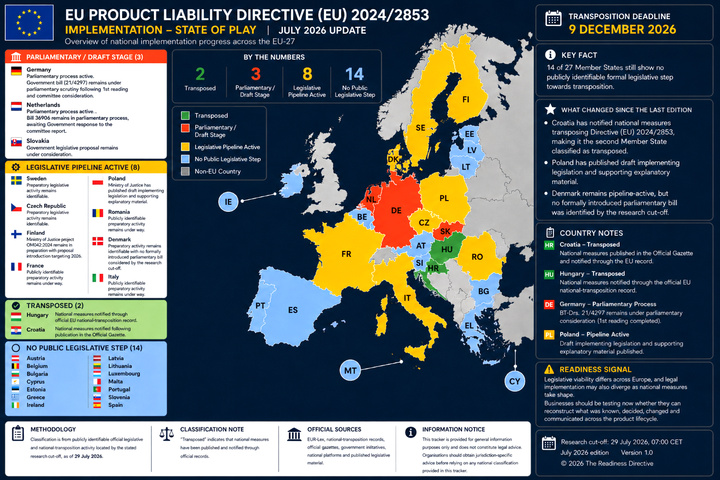
EU Product Liability Directive
EU Product Liability Directive Implementation: State of Play -July 2026
the approved Croatia/14 Member States summary