EU Product Liability Directive
EU Product Liability Directive Implementation: State of Play -July 2026
the approved Croatia/14 Member States summary
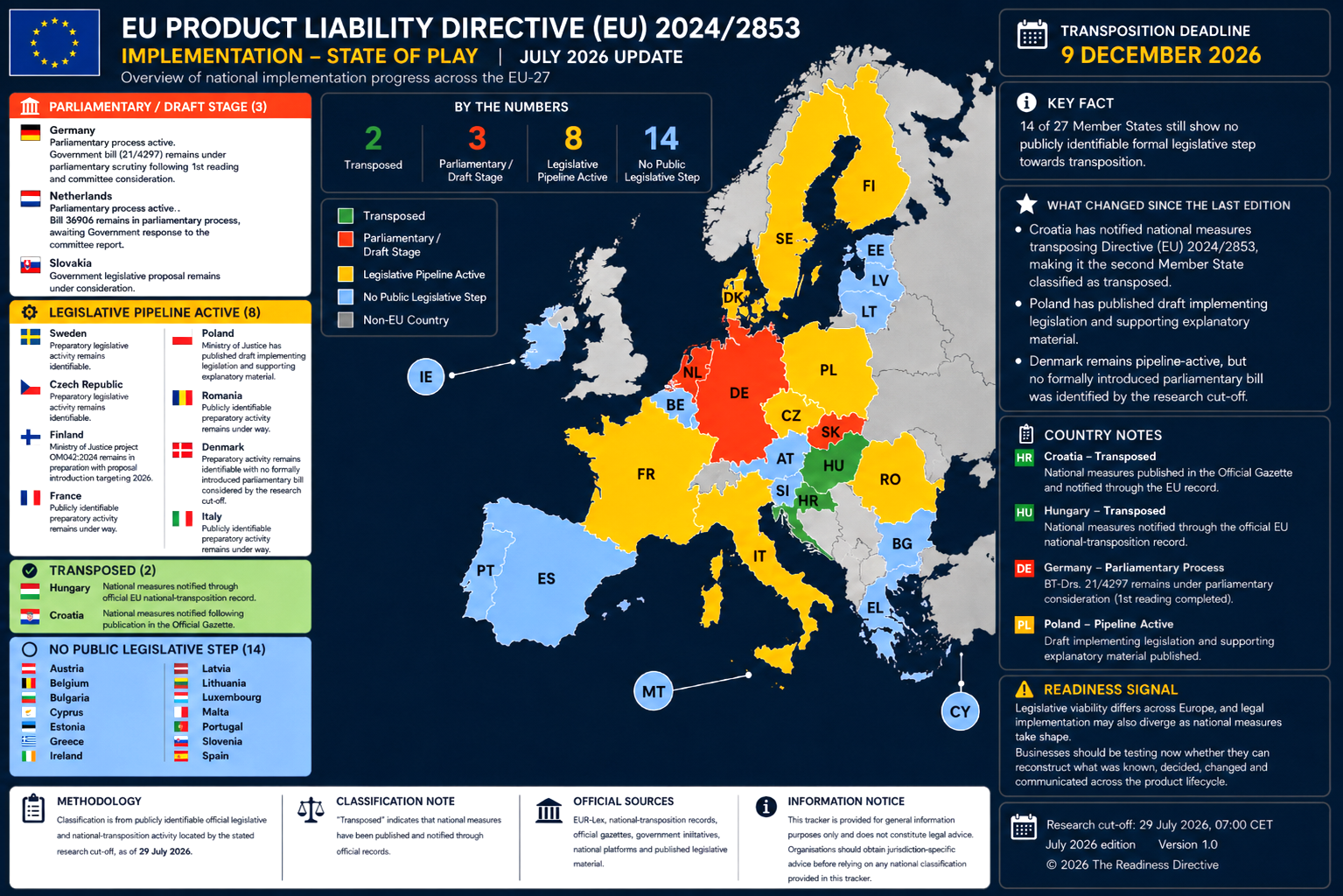
Croatia becomes the second Member State classified as transposed
Croatia has notified national measures transposing Directive (EU) 2024/2853, making it the second Member State classified as transposed in this tracker.
That is the clearest development since the last edition.
Poland has also published draft implementing legislation and supporting explanatory material, while Denmark remains classified as pipeline-active based on publicly identifiable preparatory activity. No formally introduced Danish parliamentary bill had been located by the research cut-off.
The broader European picture remains uneven.
As of 29 July 2026 at 07:00 CET, the EU-27 position recorded by The Readiness Directive is:
- 2 Member States transposed
- 3 at parliamentary or draft stage
- 8 with an active legislative pipeline
- 14 with no publicly identifiable formal legislative step
The transposition deadline remains 9 December 2026.
The July 2026 position
Transposed
Hungary
National measures have been notified through the official EU national-transposition record.
Croatia
National measures have been published in the Official Gazette and notified through the EU national-transposition record.
For the purposes of this tracker, “transposed” indicates that national measures have been published and notified through official records. Notification does not constitute a European Commission assessment that the national measures are complete, correct or fully conformant with the Directive.
Parliamentary or draft stage
Germany
Government Bill 21/4297 remains under parliamentary scrutiny following first reading and committee consideration.
Netherlands
Bill 36906 remains in the parliamentary process, awaiting the Government’s response to the committee report.
Slovakia
A government legislative proposal remains under consideration.
Legislative pipeline active
Sweden
Publicly identifiable preparatory legislative activity remains under way.
Poland
The Ministry of Justice has published draft implementing legislation and supporting explanatory material.
Czech Republic
Publicly identifiable preparatory legislative activity remains under way.
Finland
Ministry of Justice project OM042:00/2024 remains in preparation, with the proposal timetable continuing into 2026.
Romania
Publicly identifiable preparatory activity remains under way.
France
Publicly identifiable preparatory activity remains under way.
Denmark
Preparatory activity remains identifiable, but no formally introduced parliamentary bill had been located by the research cut-off.
Italy
Publicly identifiable preparatory activity remains under way.
No publicly identifiable legislative step
The following 14 Member States showed no publicly identifiable formal legislative step by the research cut-off:
Austria, Belgium, Bulgaria, Cyprus, Estonia, Greece, Ireland, Latvia, Lithuania, Luxembourg, Malta, Portugal, Slovenia and Spain.
This classification does not mean that no internal government work is taking place. It means that no official legislative step meeting the tracker’s publication criteria had been located through publicly available sources by the cut-off date.
What changed since the last edition
Three developments matter most.
Croatia
Croatia has moved into the transposed category following publication of national measures in the Official Gazette and notification through the EU national-transposition record.
The classification is based on the existence and notification of national measures. It should not be read as an independent assessment of whether every element of the Directive has been transposed completely or correctly.
Poland
Poland has published draft implementing legislation and supporting explanatory material through the Ministry of Justice.
This places Poland within the active legislative pipeline, but not yet within the parliamentary or transposed categories.
Denmark
Denmark remains within the legislative pipeline category.
Preparatory legislative activity remains publicly identifiable. However, no formally introduced parliamentary bill had been located by the research cut-off. The tracker will continue to review the Folketing record and official Danish legislative sources.
The wider finding
The most important structural finding is not simply that two Member States are now classified as transposed.
It is that 14 of the 27 Member States still show no publicly identifiable formal legislative step with little more than four months remaining before the transposition deadline.
That does not prove inactivity.
It does, however, mean that companies cannot assume that the eventual national legal position will become visible early enough to support a comfortable, sequential implementation programme.
The Directive may be European, but transposition will occur through national law. Differences in drafting choices, procedural rules, institutional practice and adjacent national legislation may affect how the new regime is applied in practice.
Legal implementation may therefore diverge as national measures take shape, even though the underlying Directive is common across the Union.
What this means for businesses
Companies should not wait for every Member State to complete its national process before testing readiness.
The relevant question is no longer simply whether the organisation has read the Directive.
The practical question is whether it can reconstruct and defend:
- what was known about a product and when;
- what risks, defects or uncertainties were identified;
- who made the relevant decisions;
- why warnings, updates, design changes or corrective actions were selected or rejected;
- how information moved between quality, legal, engineering, software, safety and post-market functions;
- whether the organisation can produce the supporting evidence in an intelligible form.
This matters because the new Product Liability Directive expands the concept of a product to include software and digital manufacturing files, addresses connected and evolving products, and introduces new disclosure and evidential mechanisms for technically complex claims.
The eventual legal framework may differ in detail between Member States.
The underlying organisational challenge will not.
Businesses will need to demonstrate how products were designed, monitored, changed, updated and governed across their lifecycle.
Readiness signal
Legislative visibility differs across Europe, and legal implementation may also diverge as national measures take shape.
Businesses should be testing now whether they can reconstruct what was known, decided, changed and communicated across the product lifecycle.
The deadline is fixed.
The visibility of the national path towards it is not.
Methodology
The classifications in this tracker reflect publicly identifiable official legislative and national-transposition activity located by the stated research cut-off.
Sources reviewed include:
- EUR-Lex national-transposition records;
- national parliamentary records;
- government ministries;
- official gazettes;
- national legislative programmes;
- published government consultation and project records.
Where no formal public step was identified, the country is recorded as showing no publicly identifiable legislative step.
The classifications are intended to describe visible legislative status, not to provide a legal opinion on the completeness, correctness or conformity of any national measure.
Research cut-off
29 July 2026, 07:00 CET
The tracker will be updated as further official national measures, parliamentary documents or legislative programmes become publicly available.
Information notice
This tracker is provided for general informational purposes only and does not constitute legal advice.
Organisations should obtain jurisdiction-specific legal advice before relying on any national classification, transposition status or implementation assessment.