EU Product Liability Directive
The Directive Is Horizontal. Your Org Chart Is Vertical.
The EU Product Liability Directive cuts across functions. The challenge before December is not rewriting policies - it is making decision rights work across the organisation.

Policies can be rewritten before 9 December. Decision rights cannot.
From 9 December 2026, the EU's new product-liability regime applies to products placed on the market or put into service after 8 December 2026, following the May 2026 corrigendum to Article 2(1). Member States are required to apply their transposing measures from that date, even as national implementation continues to progress unevenly.
Much of the visible readiness work is documentary: revised policies, reviewed technical files, scheduled training and legal assessments of exposure. All of it matters. None of it answers the harder question.
Has the organisation itself changed?
That question matters because Directive (EU) 2024/2853 does not deal only with the product as it existed when it first entered the market. Its framework expressly addresses software, updates and upgrades, related services, products capable of acquiring new features, substantial modification and circumstances in which manufacturer control continues beyond placement on the market.
Organisations, however, are built around functions. Engineering owns design and code. Quality owns controlled processes. Cybersecurity owns vulnerabilities. Procurement owns suppliers. Commercial owns product growth. Legal owns legal exposure.
The product moves through all of them.
The Directive does not assess the org chart. It assesses the product. But the questions it can raise about that product increasingly have to be answered across the organisation.
From snapshot to continuing control
Manufacturer control is broader than physical possession of the product. Article 4(5) includes components and software updates or upgrades that the manufacturer supplies, authorises or consents to, product modifications, and the manufacturer's retained ability to supply updates or upgrades itself or through a third party.
That matters because the product does not necessarily remain in the state in which it was first supplied. Software, dependencies, functionality, components and cybersecurity conditions can change after launch.
The legal question is therefore no longer only what the product was when it entered the market. It can also include what happened afterwards and whether the relevant matter remained within the manufacturer's control. Being able to answer that is an organisational capability.
Article 11 also makes the absence of change relevant. The usual exemption based on defectiveness arising after placement on the market is unavailable where, within manufacturer control, the defectiveness is due to a related service, software including an update or upgrade, a failure to provide a software update or upgrade necessary to maintain safety, or a substantial modification. The economic operator must prove the exemption on which it relies.
That raises a question vertical structures do not naturally assign:
Who owns the decision not to update?
A release normally has an owner. A decision to stop supporting, defer or not deploy a safety-relevant change can be much less obvious.
The point extends beyond updates. Article 11's development-risk defence looks at the objective state of scientific and technical knowledge not only when the product was placed on the market or put into service, but also during the period in which it remained within the manufacturer's control.
Continuing control therefore creates a continuing need to be able to reconstruct what decisions were made around the product and on what basis.
One change, several competent functions
Consider an illustrative connected life-safety product entering the market under the new regime. A later software update is proposed to reduce nuisance alarms.
Commercial sees a customer problem; Engineering sees an optimisation opportunity; Product Safety sees a potential change to detection behaviour; Cybersecurity sees a software release; Regulatory may need to consider conformity assumptions; Quality sees a controlled change.
Every function may be acting competently. The structural question sits between them.
Who decides whether the change is merely a software improvement or a safety-relevant product decision?
And if an incident occurs three years later, who owns the joined explanation?
The weakness is not necessarily missing competence. Responsibility can be distributed while the product story remains continuous.
Decision rights are the real organisational test
Cross-functional collaboration is easy to describe. Decision rights are harder because accountability for the outcome, authority to decide, the right to be consulted, the right to stop, the right to force escalation and ownership of the rationale record are different things.
An organisation can consult widely while leaving final authority ambiguous. It can assign accountability without giving the accountable person meaningful authority. It can create escalation routes without defining the threshold that triggers them. It can require cross-functional approval while never defining which decisions need cross-functional approval in the first place.
Who decides which decisions require the others?
That gateway decision determines whether apparently separate functional choices ever become an enterprise decision.
The incentive structure can make the problem harder. Engineering may be measured on delivery, Commercial on growth, Procurement on cost and Quality on compliance, while Legal may be engaged where a decision carries material exposure. Each function can be optimising rationally within its own mandate and the enterprise can still produce a poor lifecycle decision.
You cannot create horizontal accountability through vertical incentives alone.
Authority has to be designed to cross the same boundaries that product risk crosses.
Legacy edition
This earlier edition is preserved in the archive. The full original publication is available externally where a verified edition link exists.
Read the full original edition on LinkedIn ↗Related Intelligence
EU Product Liability Directive
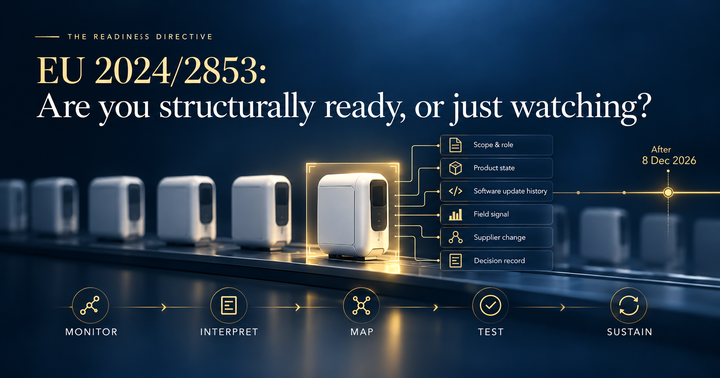
EU 2024/2853: Are you structurally ready, or just watching?
From 9 December 2026, products placed on the EU market, including products from lines already in production, enter the new liability regime. Tracking transposition will not tell you whether you could reconstruct their history.
EU Product Liability Directive
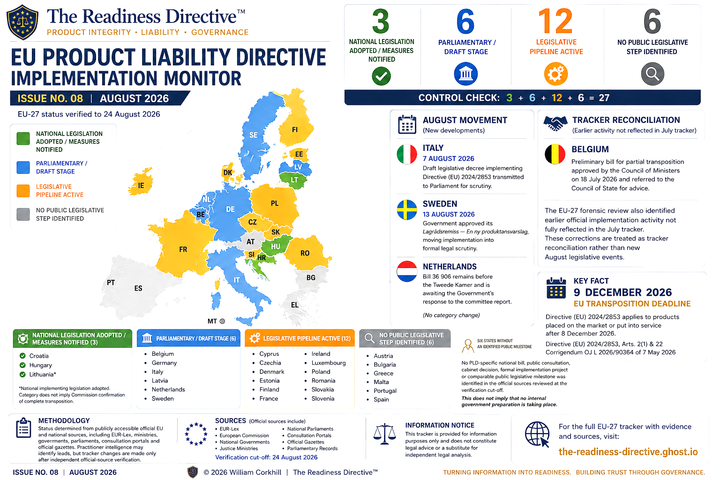
EU Product Liability Directive Implementation Monitor - August 2026
EU-27 implementation of Directive (EU) 2024/2853 is moving into formal legislative machinery. August status: 3 adopted/notified, 6 parliamentary, 12 pipeline, and 6 with no public legislative step identified.
EU Product Liability Directive
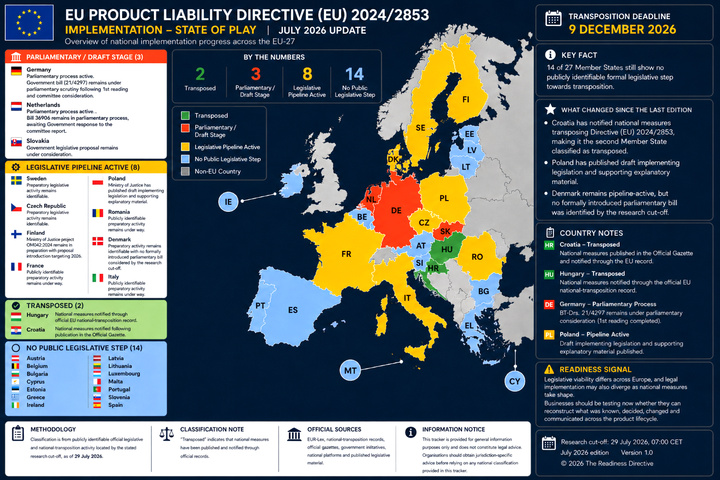
EU Product Liability Directive Implementation: State of Play -July 2026
the approved Croatia/14 Member States summary